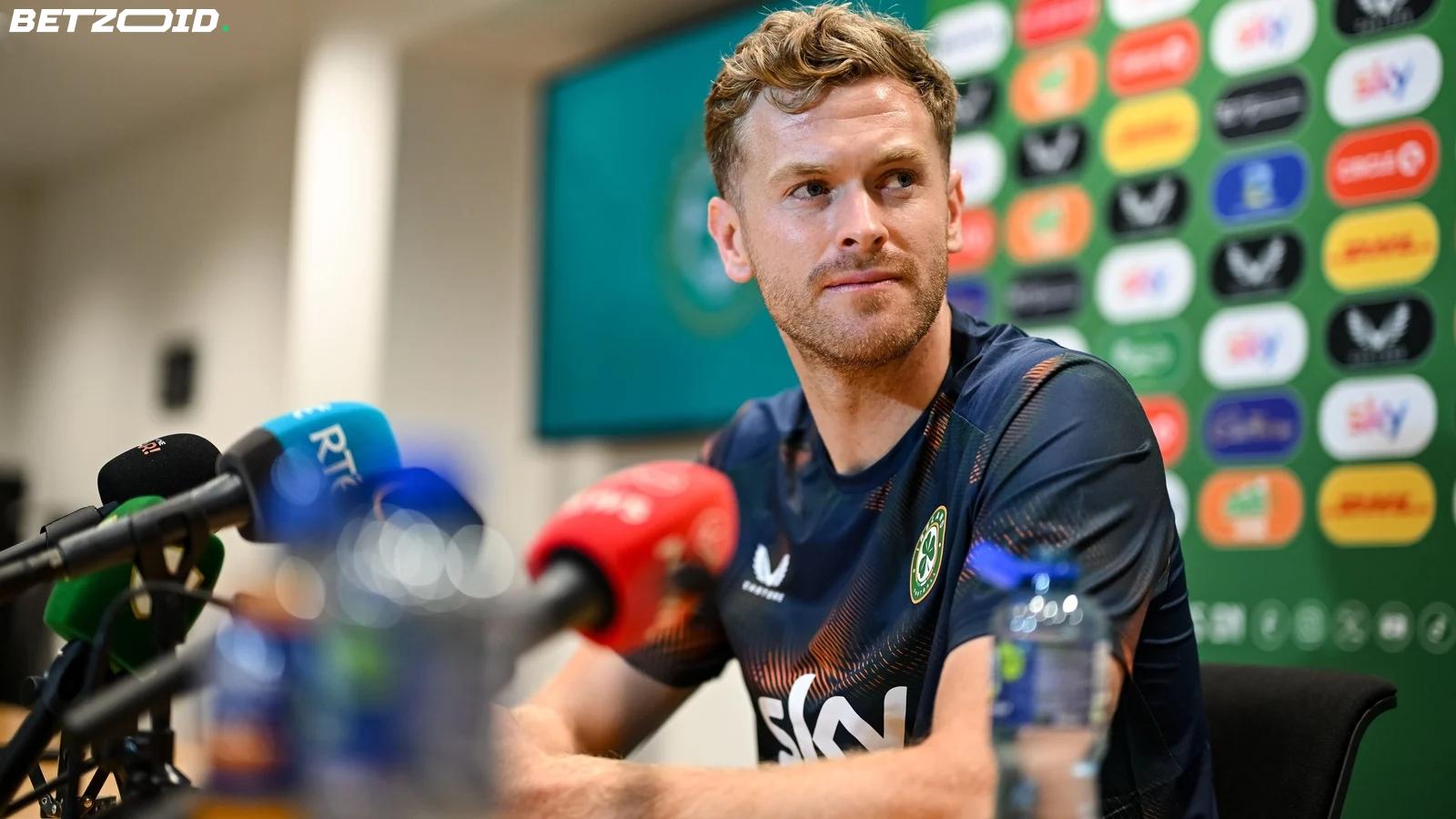
"If they are very strong about that, we can't stop them." Nathan Collins didn't dodge the Israel question — he answered it plainly, and that matters more than any diplomatic non-answer would have.
The Republic of Ireland skipper was speaking at FAI HQ ahead of Thursday's friendly against Qatar, fielding the question that's going to follow this squad around for the next four months. Ireland face Israel home and away in the Nations League — Dublin on 4 October, with the away leg expected at a neutral venue in September. A protest outside the Dáil on Tuesday made clear that public pressure isn't going away.
Trust the FAI — or at least try to
Collins' position is a careful one. He's not calling for a boycott, but he's not shutting the door on dissent either. "For players we just have to trust the FAI," he said. "We have to trust the government that they know what they're doing. We're picked to play football."
That's the line the FAI itself has been walking since February, when CEO David Courell pointed the finger at UEFA — essentially arguing that Israel's participation is out of their hands. Convenient, perhaps, but not entirely untrue. UEFA hasn't moved.
What Collins is signalling is that the dressing room won't try to police individual players who feel differently. What that looks like in practice — pre-match gestures, public statements, refusing to play — he left deliberately vague. "What we'd speak about is hard to say, because you need the whole group together." A genuine answer, actually.
Collins finding his feet as captain
Away from the political noise, Collins has had a season worth examining. He was dropped to the bench at Brentford in late January, spent six weeks watching from the sidelines, and had to fight his way back into the XI by March. By the end of the campaign, the Bees finished a point off Europe — kept out only on goal difference after a 1-1 draw with Liverpool on the final day.
"Individually I had a lot of ups and downs," he admitted. Taking on the captaincy at club and country simultaneously at 25 clearly weighed on him early. "I took too much on and took it too seriously, and I tried to change too much." He's not the first player to let the armband constrict him before it liberates him.
The return of Seamus Coleman and John Egan to the Ireland setup helped — not tactically, but psychologically. It freed Collins to concentrate on his own game rather than trying to carry everything himself. His performances picked up accordingly.
Brentford's near-miss in Europe and the pain of Prague — where Ireland's Nations League run ended in the cruelest fashion — has sharpened something in him. "There's a bite in me, wanting to succeed more for Ireland," he said. Whether that translates into a meaningful push in the upcoming cycle depends on a lot more than one captain's appetite. But the Israel fixtures will dominate the headlines long before a ball is kicked in anger.