Madonna and Justin Bieber closed out the World Cup final. Spanish players got championship rings. FIFA sold replicas for $12,000. If you watched the 2026 tournament and thought it felt more like a Super Bowl than football's global showpiece, you weren't wrong — and a lot of what you saw is coming back.
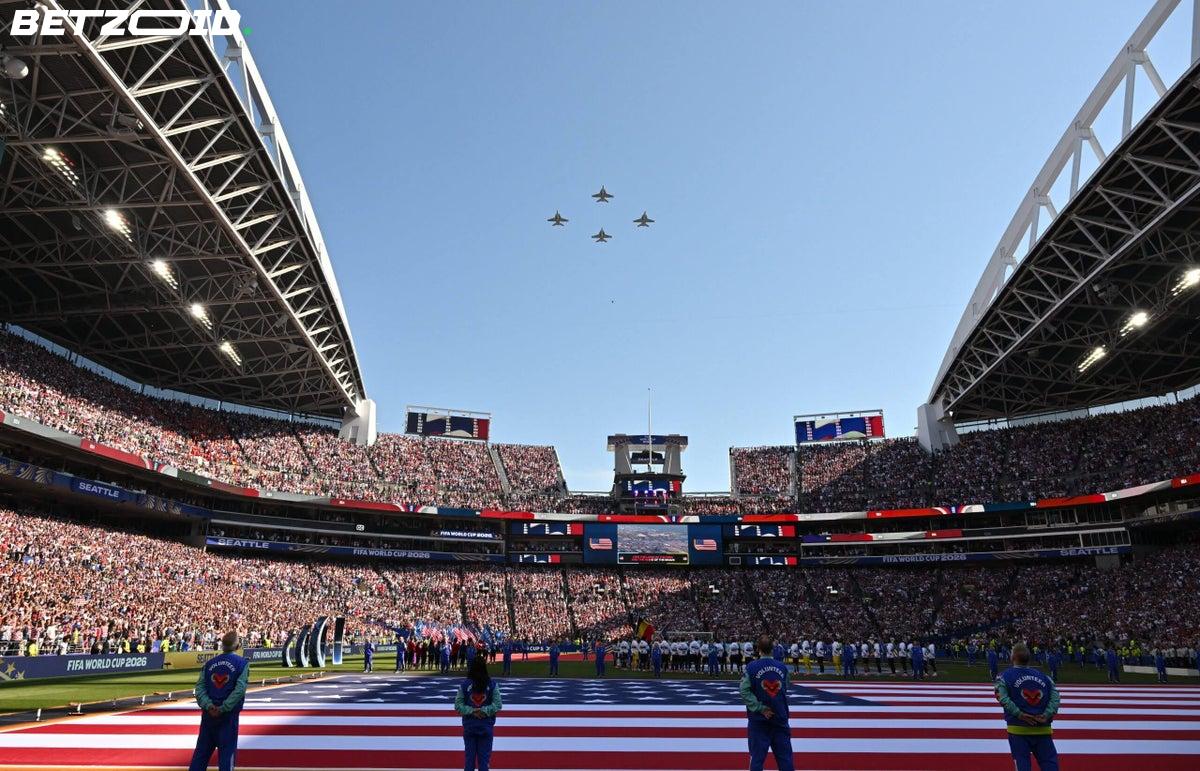
For 39 days across the United States, FIFA leaned hard into American consumerism. Dallas Cowboys cheerleaders. The Buffer brothers. Flyovers. A Tom Cruise prelude to the final. A halftime show that stretched a standard 15-minute break to 27 minutes. Steve Aoki deejaying at a World Cup semifinal. Zac Brown Band playing "Chicken Fried" from a concourse in Dallas at halftime. Surreal stuff — and every bit of it was deliberate.
The hydration breaks aren't going anywhere
The mid-half hydration breaks drew the loudest complaints from football purists. They killed momentum. They handed coaches tactical reset buttons they've never had before. At the 39 indoor matches played in climate-controlled conditions, they were almost impossible to justify on sporting grounds.
But they'll be back.
FIFA president Infantino framed them as a purely sporting matter — "the main reason is the heat" — and the rationale conveniently works in perpetuity. Spain and Morocco in June can hit the 80s and 90s Fahrenheit. The 2031 Women's World Cup returns to the U.S. The 2034 men's tournament heads to Saudi Arabia. There will always be a heat argument available.
More importantly, broadcast money is reshaping the calculus. FIFA's existing deals were signed before the breaks were introduced, so the direct financial windfall went to broadcasters like Fox, who could suddenly sell mid-game ad slots. But FIFA's upcoming rights negotiations — for 2030 and 2034 — will be conducted with everyone knowing those breaks exist. Broadcasters will pay more knowing they can monetise inside 90 minutes. As broadcast executive David Levy put it: "It would be hard to move backwards once hydration breaks have been shown to work because of the dollars associated with it. And if it's not hydration breaks, it will be something else."
That "something else" line should concern everyone who values football's uninterrupted flow.
Ticketing: briefly chaotic, structurally unlikely to repeat at the same scale
Before a ball was kicked, FIFA's ticketing strategy was already generating fury. The "right to buy" fees. Prices raised between sales phases. A FIFA-run resale platform taking a 30% cut on every transaction. Accusations of betrayal from fan groups, and investigations opened in both the U.S. and Europe.
None of it stopped FIFA in 2026. But 2030 is a different market. Spain, Portugal and Morocco — the three main co-hosts — have less purchasing power than North America. Portugal restricts ticket resale by law. European courts have looked at FIFA's commercial practices with considerably less patience than American regulators. The convenient excuse that North American ticket markets "are just like that" won't survive translation to Madrid or Casablanca.
Prices will almost certainly still be the second-most expensive in World Cup history. FIFA secretary general Mattias Grafström, when pressed on the fan anger, pointed to the redistribution of revenue to 211 member associations. The redistribution argument is real — but it doesn't explain why a fan in Seville should pay three times the going rate for a domestic top-flight match just to watch Portugal play.
The halftime shows, the hype men, the cameras hunting celebrities
Inside stadiums, the 2026 experience was relentless. Video boards the size of buildings. Fan cams. Decibel meters. Power rankings for players, presented in a format clearly designed for people who had never watched a football match. Announcements urging crowds to "make some nooooiiiiise." Three national anthems performed live at the final, rather than the instrumental versions that traditionally let fans and players generate their own atmosphere.
It left little organic space. The football itself was fine — often excellent — but the presentation often felt like it was ashamed of the silences that make football football.
Some of this scales down naturally in 2030. SoFi Stadium's monstrous video board doesn't travel to Seville. Dallas Cowboys cheerleaders have no obvious equivalent in Lisbon. Spanish and Moroccan audiences have their own football culture and won't need hype men to manufacture it.
But conceptually, FIFA has decided the World Cup final is a halftime show event now. The logic isn't completely irrational — there are BTS fans who've never heard of Rodri, just as the NFL courts Bad Bunny listeners who don't know the Super Bowl champions. Whether it's the right trade-off for football is a separate question. FIFA has already answered it.
"The modus operandi of modern-era FIFA is to go bigger and bolder," and this tournament was the proof of concept. Country music and cheerleaders won't be in 2030. But non-football entertainment at the final? That's the new normal — and FIFA has no institutional incentive to walk it back.