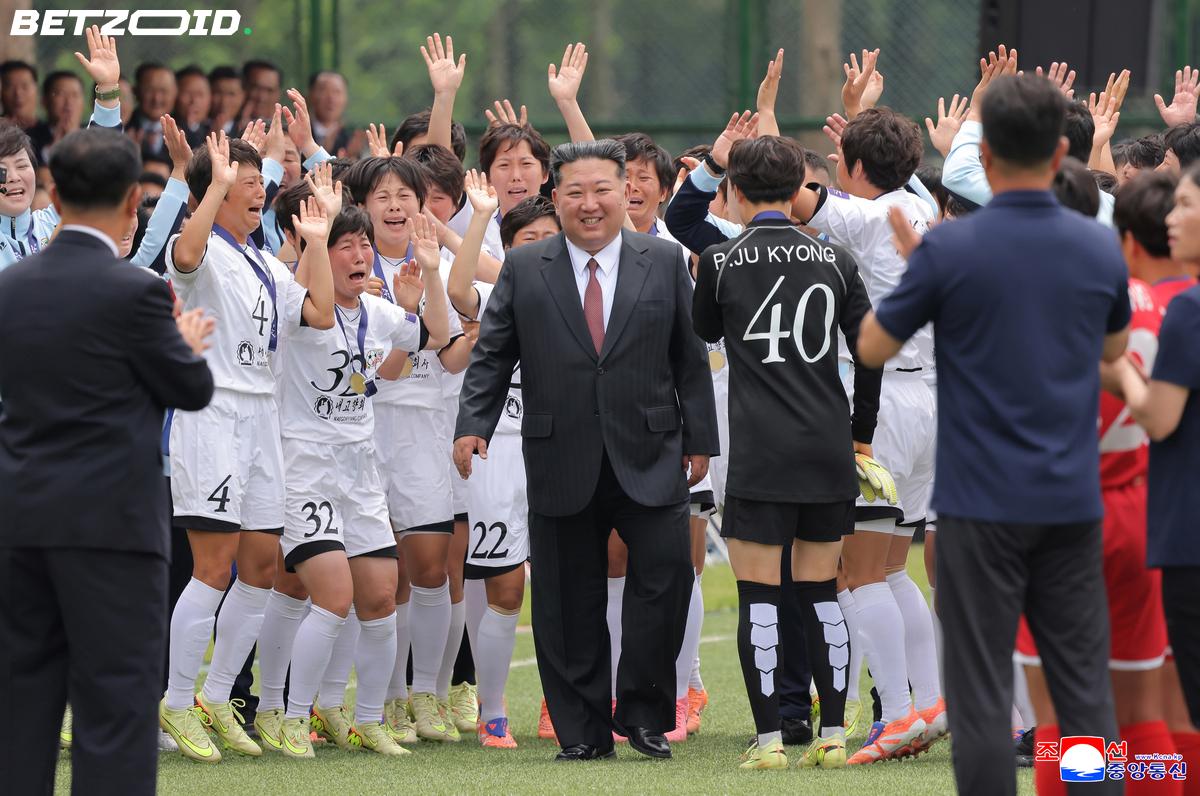
Kim Jong-un didn't show up to watch football. He showed up to make a point — and the gold medals around the players' necks were the prop.
On October 1st, North Korea's state-run Korean Central News Agency reported that Kim attended a demonstration match between Naegohyang Women's Football Team and the U-17 women's national team, held as the closing event of the 80th anniversary celebrations of the Workers' Party of Korea's Central Cadres School. Both sides had legitimate reasons to celebrate: Naegohyang had just won the AFC Women's Champions League, with the semifinals and final staged in Suwon, South Korea, while the U-17 squad claimed the AFC Women's Asian Cup.
Kim met coaches and players from both squads before kick-off, shook hands with medal-draped athletes, and posed for photographs. North Korean state media published images of players visibly emotional — some appearing to cry — while Kim smiled in the foreground. Rodong Sinmun, the outlet read by ordinary North Koreans, ran the coverage across four of its six pages. That's not sports journalism. That's political theatre.
Sport as a loyalty instrument
Yang Moo-jin, a distinguished professor at the University of North Korean Studies, laid it out plainly: "By linking the achievements of women's soccer to the consideration and benevolence of the supreme leader, they sought to elicit loyalty." The match's venue — in front of an audience of party cadre school attendees — wasn't incidental. It was the message. International success equals party leadership. Party leadership equals Kim.
The wider context makes this sharper. In his speech at the same anniversary event, Kim explicitly called out ideological drift among younger cadres, warning that those "who have not experienced stern ordeals such as war and reconstruction are increasingly showing differences from previous generations in their spiritual world and dignity." He demanded higher standards of "Party tempering" for younger officials. The football showcase was the carrot. The speech was the stick.
What this means beyond the spectacle
For the players themselves, the AFC Champions League win was a genuine sporting achievement — Naegohyang beat clubs across Asia to claim the title, and the U-17 squad's continental success adds another layer. North Korean women's football has quietly built real pedigree at the youth and club level over the past decade.
But inside North Korea, results like these are never allowed to just be results. They get absorbed into the apparatus. The scoreboard at the stadium listed Naegohyang's opponents as 'Jang Subong' — believed to refer to the U-17 national team — while the perimeter was packed with flag-waving attendees. A football pitch surrounded by ideological instruction.
Kim's core message to the cadre school was unambiguous: the younger generation needs harder ideological shaping, because softness is a structural threat to the regime. Two teams of women holding gold medals were drafted in to illustrate what loyalty and achievement look like under the party's guidance.
"The younger the generation, the more they must devote greater effort to Party tempering," Kim said. The Naegohyang players, tears on their cheeks and medals round their necks, were the evening's most visible evidence of that doctrine in action.