"People see too much bad news," Ricardo Adé says. "Once you step foot in the country, you're going to see other things." The 36-year-old defender has carried that thought through qualifying, through every away match Haiti played — because they played every single qualifier away from home — and now into a 2026 World Cup where his team face Scotland first, then Brazil on Juneteenth in Philadelphia.
Haiti haven't been at a World Cup since 1974. Fifty-two years. Most of their players weren't born yet. Several weren't born in Haiti at all.
Not a diaspora project — a national team
Only 10 of Haiti's 26-man squad were born in the country, which makes the obvious question inevitable: is this really a Haitian team, or an exercise in passport football? Agent Tamy Michel, who represents several of the squad's key figures, pushes back hard on that framing. "I see a national team," she says.
The distinction matters when you understand what these players actually chose. Jean-Ricner Bellegarde came through French youth football, earned caps at youth level for France, established himself in the Premier League with Wolves, and still picked Haiti. Wilson Isidor helped Sunderland finish seventh in the Premier League this season and could have chased a more glamorous international career. Duckens Nazon, Haiti's record goalscorer, built a career across France, England, Turkey, and Iran. These weren't players who couldn't get a call-up elsewhere. They made a choice.
"It's home," Michel says. "It connects them to their parents and where their families come from."
That kind of buy-in is hard to manufacture. It's the sort of thing that makes a team dangerous when the odds say they shouldn't be.
The weight they're carrying into the tournament
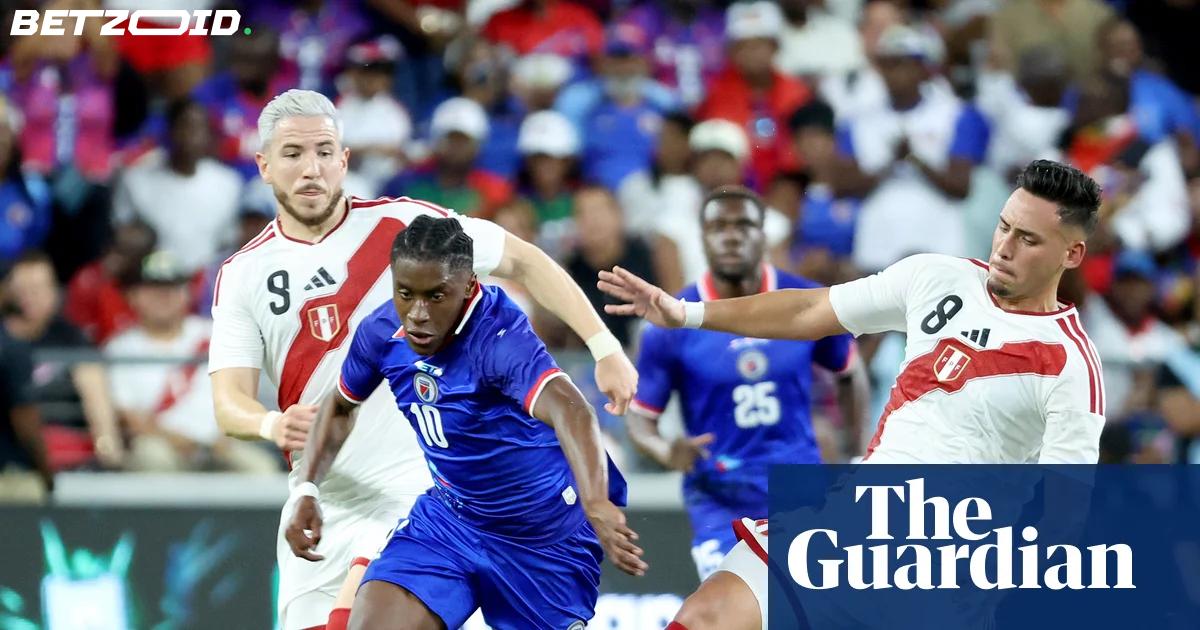
Haiti haven't played a home match since 2021. Their fanbase at this World Cup will come almost entirely from the diaspora — New York, Boston, Montreal, south Florida, wherever Haitian communities have put down roots. A friendly against Peru in Miami last week drew around 27,000 spectators. Michel estimates more than 20,000 were Haitian. Scottish officials are bracing for something similar in Foxborough on Sunday, where the Tartan Army might actually be outnumbered.
The Juneteenth match against Brazil in Philadelphia — five-time world champions against a team returning after half a century away — will be something else entirely. A gathering of a nation that can't always gather in one place.
Adé understands the symbolic stakes as clearly as anyone. He grew up in Haiti before building his career across the Americas, which gives him a perspective his France-raised teammates don't quite share. "Now soccer is the face of Haiti," he says. "The thing we are doing is showing Haiti in a different way. Showing that we can have less, but we can do much."
There's history to lean on too. In 1974, Emmanuel Sanon ended Dino Zoff's legendary run of minutes without conceding — the goalkeeper who never let anything in, undone by a Haitian striker on the biggest stage in football. And further back still, Joe Gaetjens, born in Haiti, scored the goal that gave the USA their famous 1950 upset of England. Haiti's fingerprints on World Cup history are older and deeper than most people realise.
- Jean-Ricner Bellegarde — Wolves (Premier League)
- Wilson Isidor — Sunderland (Premier League)
- Duckens Nazon — Haiti's record goalscorer
- Ricardo Adé — LDU Quito, one of South America's most respected defenders at 36
Against Scotland on Sunday, Haiti open as underdogs. That's fine. "People forget that football is played on the field," Michel says. "They look at statistics and rankings and assume Haiti can't compete. But at the end of the day, it's 11 against 11."
"We've been fighters for a long time," Adé says. That's not a rallying cry for the cameras. For this squad, it's just accurate.