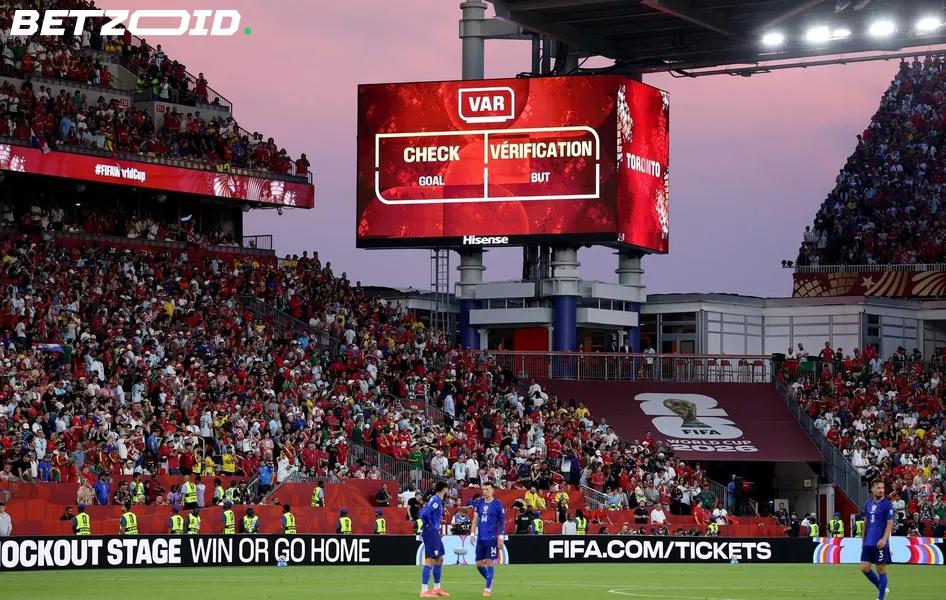
"All these decisions take the joy out of football." Croatia manager Zlatko Dalic said it, and after watching his side eliminated on a goal disallowed because a microchip detected a player's hair grazing a ball — without even changing its trajectory — it's hard not to feel the weight of that.
Portugal's 2-1 round of 32 win over Croatia will be remembered less for the football and more for what happened in the 13th minute of stoppage time. Josko Gvardiol thought he'd levelled it. The stadium erupted. Then VAR intervened — not because a camera angle caught something suspicious, but because a sensor embedded in the Adidas Trionda ball registered that Igor Mantanovic had made the faintest contact with his head in the build-up. The kind of touch nobody in the ground saw. The kind of touch that didn't move the ball a millimetre.
Croatia were out. Portugal moved on.
When precision becomes the problem
FIFA was quick to explain the mechanics. The Trionda ball's internal sensors are "capable of determining any slight contact," displayed to viewers via a "heartbeat graphic" during broadcasts. The system did exactly what it was designed to do. That's almost the issue.
Roberto Martínez, to his credit, was straightforward about it: "The balls now have a chip, and it's very clear that's why the VAR intervened. It's not a subjective opinion." He's right. It isn't subjective. But football has never been purely about what's technically correct — it's about what humans can perceive, contest, and emotionally process in real time.
The back-pass rule in the 1990s changed how teams played. Goal-line technology ended arguments about whether the ball crossed the line. Semi-automated offside shortened delays. Each step felt like progress because the errors being fixed were visible ones — moments where the naked eye clearly got it wrong. A hair touch that changes nothing about the play sits in different territory entirely.
The US red card via VAR earlier in the knockout rounds raised similar questions. Slow-motion replay doesn't just clarify contact — it amplifies it, making routine challenges look cynical and glancing touches look deliberate. The lens distorts as much as it reveals.
Controversy hasn't disappeared — it's just wearing different clothes
Technology was supposed to reduce the arguments. In some ways it has. Mistaken identity, phantom penalties, dangerous fouls missed from the referee's angle — VAR has quietly corrected all of those. But the 2026 knockout rounds have produced a cluster of controversies that wouldn't have existed at a lower-tech World Cup, simply because they wouldn't have been detectable.
That's the paradox. The more precisely you measure, the more edge cases you surface. And edge cases in a World Cup knockout tie don't feel like technical footnotes — they feel like injustice to the side going home.
From a betting standpoint, tournament odds are increasingly shaped by how VAR-heavy the officiating environment is. A team like Croatia, built on defensive resilience and set-piece threat, is exactly the profile that gets hurt most by decisions in the margins — tight offsides, micro-contacts, moments where the technology sees what tactics cannot protect against.
Dalic's complaint will fade. Croatia will regroup. But the question his words raise won't go away: at what point does accuracy become its own form of distortion?