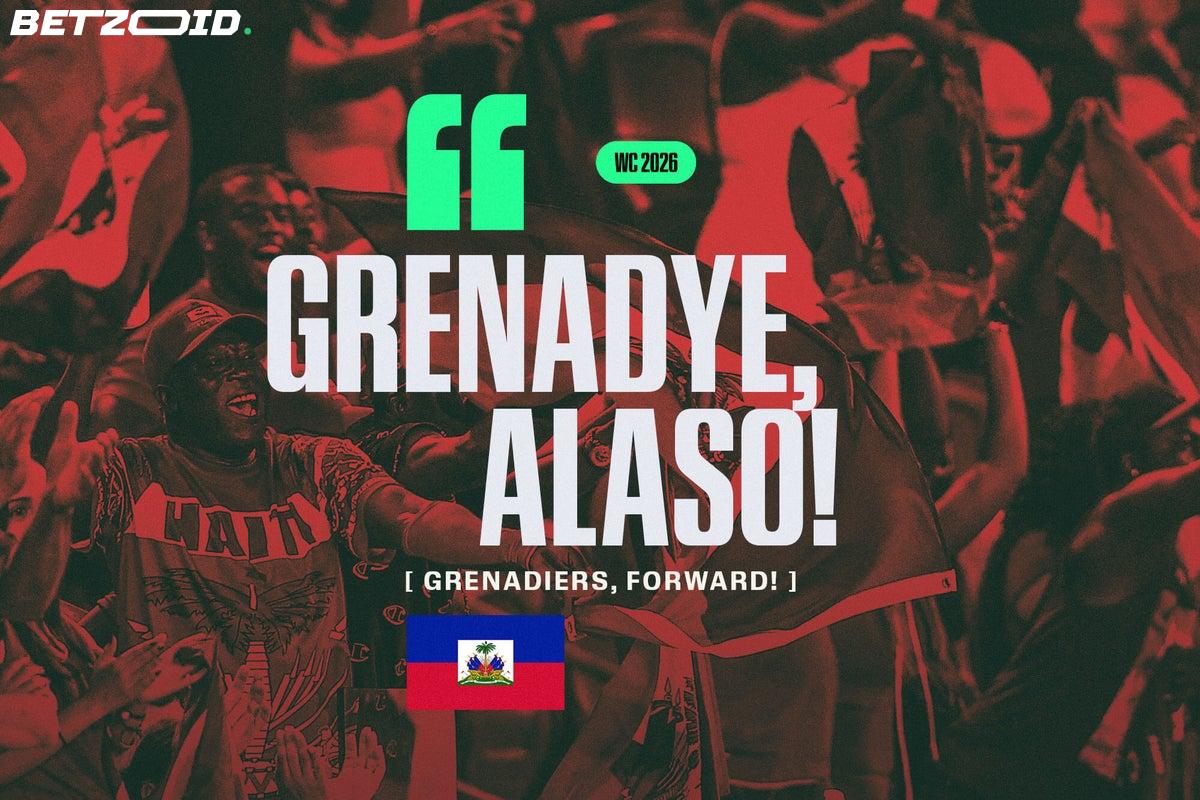
"We're going through a lot of turmoil in Haiti, and really there's nothing that can unite us the way soccer can." Jacob Herard, a New York-based supporter, doesn't need to explain what he means. The context writes itself.
Gangs control an estimated 80 to 90 percent of Port-au-Prince. The national stadium is among the territory they hold. Haiti played every single home qualifier in Curacao. Some players on the squad have never set foot in the country they represent. And yet — Haiti is going to the 2026 World Cup, their first appearance since 1974.
They finished top of a Concacaf qualifying group that included Costa Rica and Honduras, two nations with recent World Cup experience. That's not a fluke. That's a team that found a way when every logistical and human circumstance was stacked against them.
The phrase that predates football by two centuries
The rallying cry Haitian fans bring to matches — "Grenadye, alaso!" — translates from Haitian Creole as "Grenadiers, forward!" and carries considerably more weight than a terrace chant normally would. It traces back to the early 1800s, when Napoleon sent what was at the time the largest expedition ever to leave France, aimed at reinstating slavery after Haitian revolutionaries had forced its abolition.
French troops shouted "Grenadiers, a l'assaut!" as a charge command. Haitian revolutionaries took that phrase, rewrote it into a song, and turned an enemy battle cry into their own call to fight. Marlene Daut, professor at Yale and co-winner of the 2024 Frederick Douglass Book Prize for her work on the Haitian Revolution, puts it simply: they "reinterpreted it to be something that would inspire them instead of cause them to retreat."
That lineage matters when you hear it echo around a stadium in Boston or Philadelphia or Atlanta — all three cities hosting Haiti's 2026 group-stage matches.
What to expect in the stands
Expect rara bands. Drums. Trumpets. Jean Rene Destin, an Atlanta-based fan, recalls Copa America Centenario in New York where Haitian supporters spent two to three hours celebrating in the streets after the final whistle — win or lose — until police had to manage traffic around them.
Haiti's group pits them against Morocco and Brazil. Nobody is listing them as favorites, and that's fine. There's genuine belief among supporters that this squad can be competitive in the way Costa Rica was in 2014, when the Ticos emerged from a group containing Uruguay, Italy, and England before taking Greece to a penalty shootout in the last 16 and the Netherlands to penalties in the quarterfinals. That's the ceiling Haiti's fans are pointing at.
Whether the football matches the ambition remains an open question — their odds reflect that clearly. But Jude Bernard, who travels to many of Haiti's matches from Florida, frames it in terms the betting market can't quite price: "Supporting the national team is more than football. For me, it's about identity. It's about pride and hope for the country."
The Haitian diaspora in the northeastern United States is large, organized, and loud. Boston and Philadelphia venues will feel that. Atmospherically, Haiti will not be the underdog in the stands.
"We're proud to be Haitians and we're not hiding it," says Destin. "People are constantly trying to belittle you. And then we still rise up."
Nou la toujou. We are still here.