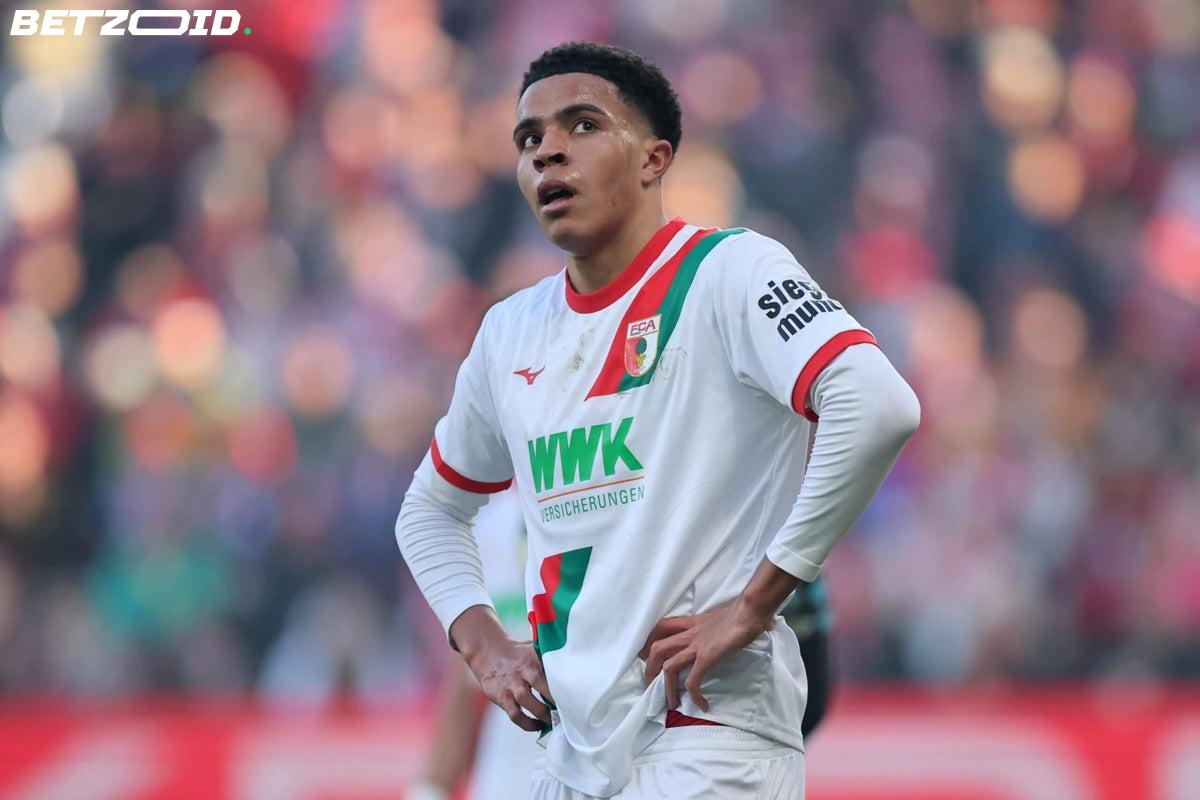
"I don't want to make my decision dependent on a World Cup." That one line from Noahkai Banks tells you everything about where his head is — and why reducing this to a simple question of loyalty misses the point entirely.
Banks is 19, born in Hawaii, raised in Bavaria since he was seven weeks old. He speaks German as his first language. His football education came entirely through the Augsburg academy. He is now a Bundesliga central defender at an age when most players are still dreaming about it. The kid is good — genuinely good — and both the United States and Germany know it.
What's actually at stake for the USMNT
Mauricio Pochettino is actively recruiting him. That alone signals how seriously the U.S. federation is taking this. Banks has already represented the U.S. at U-17, U-18 and U-20 level, and got a senior camp look last September under Pochettino — not as a matchday player, but as someone being introduced to the culture, which is a very deliberate move from a manager who described himself as more of a father figure in these conversations.
A home World Cup opens in June. If Banks commits and keeps developing at his current pace, he's a realistic candidate to be in that squad as the youngest player. That's not a small thing. But Banks has been clear: he's not letting the tournament calendar make this decision for him.
Pochettino confirmed the dynamic plainly: "He is thinking a lot. He is in a situation that is not easy for him. He was very clear he was not available to be selected."
The Donovan take — and why it doesn't hold up
Landon Donovan, who co-hosts the Unfiltered Soccer podcast with Tim Howard, has weighed in. His proposition: FIFA should simply mandate that players represent the country where they were born. Clean, simple, and almost entirely unworkable.
If that rule existed, the current U.S. pool loses Antonee Robinson, Sergiño Dest, Gio Reyna, Malik Tillman, Sebastian Berhalter and Cameron Carter-Vickers — all born abroad. The 2014 U.S. team that reached the round of 16 included five German-Americans selected by Jurgen Klinsmann: John Brooks, Jermaine Jones, Fabian Johnson, Timmy Chandler and Julian Green. Donovan's frustration at being cut from that squad is well documented — his memoir describes watching German-Americans get selected ahead of him and wondering whether some of them even cared about the result. That bitterness is understandable. It is not a policy.
"The challenge I have," Donovan said, "is if you have to recruit someone and convince them to play for your national team, that's a problem." Tim Howard, who had Hungarian eligibility through his mother, put it differently: "It causes its own problems when someone doesn't just jump at the opportunity to play for the U.S."
Both takes carry real emotional weight. Neither one reflects what dual nationality actually looks like for the player living it.
Banks isn't stalling or angling for leverage. He grew up German. He thinks in German. He plays in Germany. The idea that he owes the U.S. an obvious, enthusiastic yes — simply because of where his mother happened to give birth — is a stretch. FIFA's one-time switch protocol exists precisely because identity is not always determined by a birth certificate.
- Banks has represented the U.S. at U-17, U-18 and U-20 level
- He is a starting central defender in the Bundesliga at 19
- Germany have not yet made formal contact, but the option is open
- Under FIFA rules, he can switch once — but must not have played a competitive senior international
The wait-for-Germany angle is real. Die Mannschaft are rebuilding after a difficult few years, and a Bundesliga-developed centre-back with dual eligibility fits exactly what the next generation of that program could look like. If Germany come calling with genuine intent, Banks will have to weigh four World Cup wins and a culture he actually belongs to against the chance to anchor a U.S. defense at a tournament being played in his birth country.
"I feel connected to both nations," he said. That's not fence-sitting. That's just true.