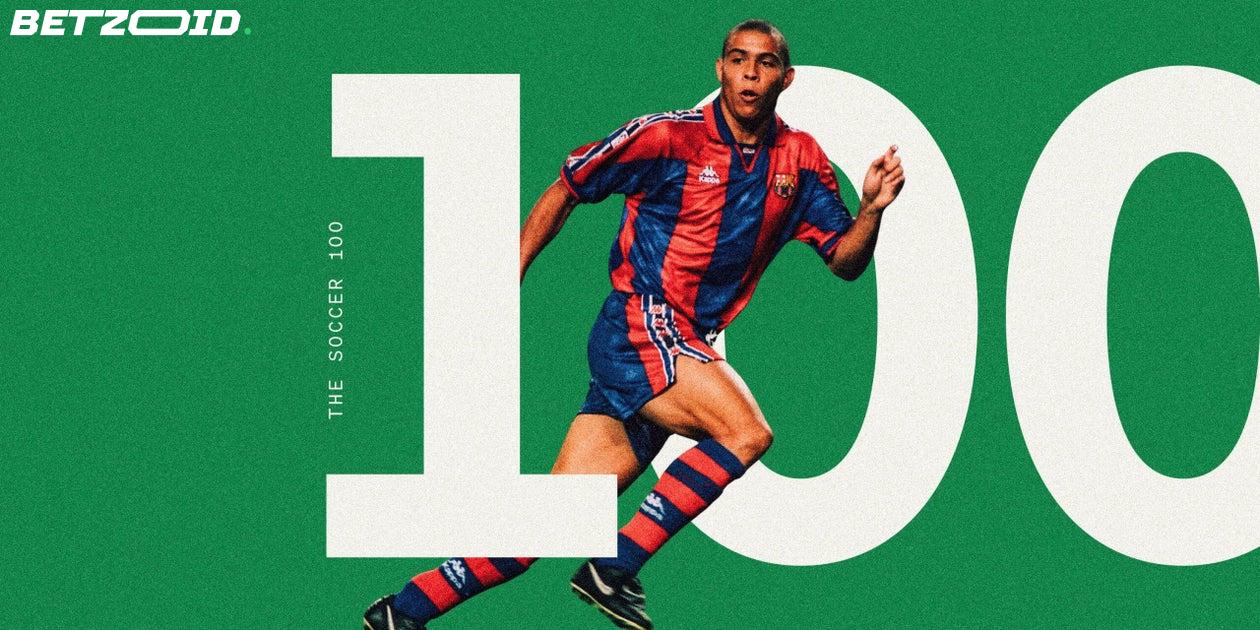
"Can anybody, anywhere, show me a better player?" Bobby Robson asked the media after Ronaldo scored against Compostela in October 1996. The answer, at that moment, was no. It still might be.
The Athletic's new book The Soccer 100 devotes a chapter to Ronaldo's single season at Barcelona — 1996-97 — and makes a case that's hard to argue with: that one year, at one club, was the peak of centre-forward play. Full stop. Not just for Ronaldo. For the position itself.
47 goals, one season, one alien
The numbers alone are absurd. Ronaldo scored 47 goals in 49 games. He won the UEFA Cup Winners' Cup, scoring the only goal against Paris Saint-Germain in the final. He became the youngest Ballon d'Or winner in history later that year. Barcelona still missed the league title by two points — largely because Ronaldo was away on international duty for a 2-1 loss to Hércules in the run-in — which tells you something about how fine those margins were.
But the numbers don't fully capture it. His team-mate Luis Enrique, who had seen everything Spanish football had to offer, put it plainly in 2017: "He's the most spectacular player I've ever seen. He did things I'd never seen before. We're now used to seeing Messi dribble past six players, but not then."
The goal against Compostela on October 12, 1996 is the one that keeps coming up. Two defenders crash into each other before he's even touched the ball. A midfielder grabs a fistful of his shirt — useless. He accelerates into the area, the angle narrows, so he cuts back, his feet going at a speed the eye struggles to follow, and sweeps it into the corner. Robson threw his hands in the air on the touchline and then clasped them to his head like a man who'd just witnessed something he couldn't entirely process. That reaction tells you more than any match report.
Óscar García, who played in that Barcelona squad and later worked at the club during Messi's prime years, was asked to compare the two. "I've never seen anything like Ronaldo," he said. That's not nostalgia. That's a man who watched Messi at the Camp Nou saying someone else left a deeper impression.
The knee that changed everything
Robson had to fight to sign him. Barcelona president Josep Lluís Núñez wasn't convinced, repeatedly questioned whether this 20-year-old Brazilian was worth the money, and at one point told Robson directly: "You know your job depends on this?" The fee rose from an initial $10m estimate to $20m — a world record at the time — before the deal was done. Ronaldo scored five minutes into his debut.
But underneath all of it, a clock was ticking. Ronaldo had been diagnosed with Osgood-Schlatter disease and trochlear dysplasia — two separate knee conditions, both aggravated by exactly the kind of explosive twisting and turning that made him special, and neither correctable by surgery at the time. The trips back to Brazil that irritated Barcelona supporters weren't jollies. He was seeing knee specialist Nilton Petrone, trying to manage a problem that had no clean solution.
His first serious injury at Inter in November 1999 looked routine — a ligament tear, he walked off. The scan told a different story. Then in April 2000, six minutes into his comeback against Lazio, his foot planted and the rest of his body kept moving. His kneecap tendon tore completely. "His kneecap actually exploded and it ended up in the middle of his thigh," Petrone said later.
He was 23.
After that, the explosiveness that had made him genuinely look like something football hadn't encountered before was gone. What remained was still elite — he scored eight goals at the 2002 World Cup, including both in the final against Germany, and finished as top scorer. But it was a different player operating at a different register. The Brazilian newspaper O Globo described his comeback as "the classic journey of the mythological local hero who descends into Hell then comes back to change history." Poetic. Also true.
- 47 goals in 49 games at Barcelona, 1996-97
- UEFA Cup Winners' Cup winner, scoring the only goal in the final
- Youngest ever Ballon d'Or winner at the time
- Eight goals at the 2002 World Cup — tournament top scorer
- Two goals in the final against Germany
- 305 career goals across Cruzeiro, PSV, Barcelona, Inter, Real Madrid, Milan and Corinthians
The honest question the book raises is whether a player who was truly at his peak for roughly two and a half years deserves to rank among the all-time greats. It's a fair debate. But Robson's question from that touchline in Galicia in 1996 has never really been answered. Nobody has shown him a better player.