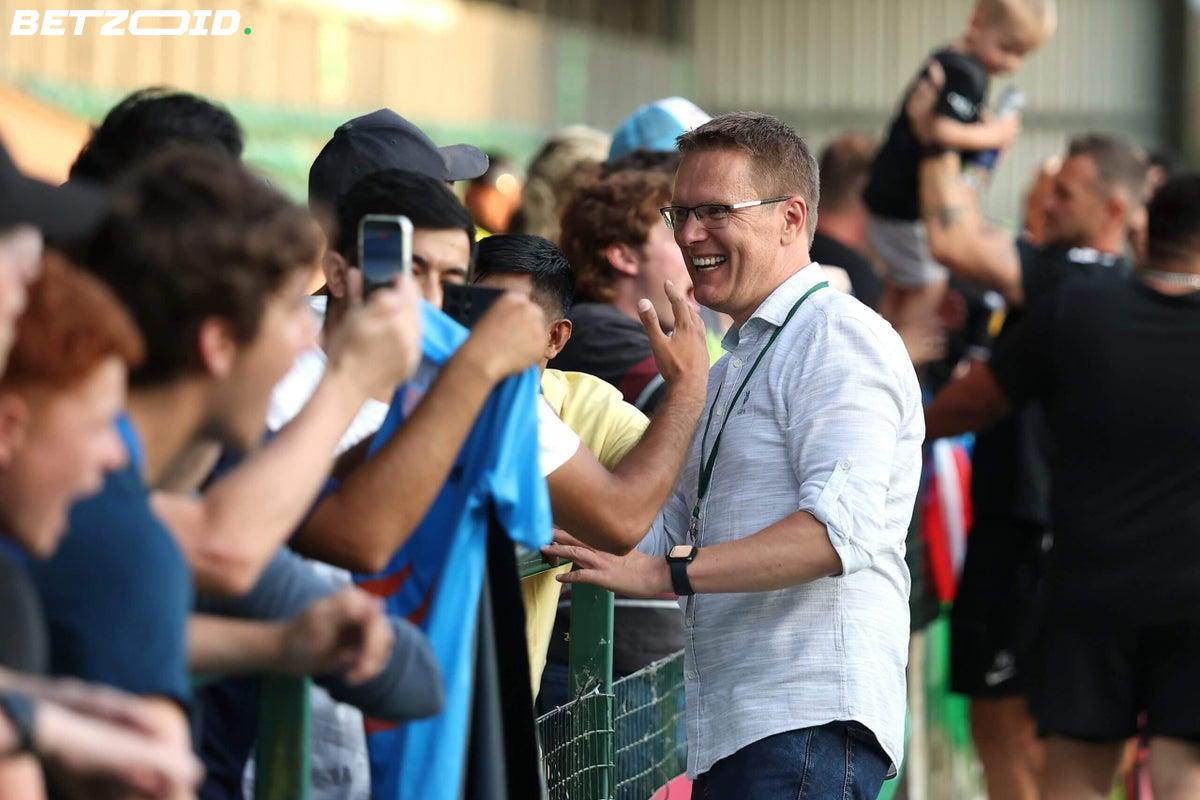
Twenty-four years ago, Valdas Dambrauskas won the equivalent of six months' average Lithuanian wages on a game show based on Who Wants To Be A Millionaire? — roughly £725 — and used it to move to London with his girlfriend and a plan. On Thursday, he walks out at Old Trafford to manage Sabah FK against Manchester United in the Champions League.
That game show money funded everything. The coaching courses. The university fees. The years of cleaning pub floors, delivering newspapers, working as a childminder, a handyman, a nursery assistant — often four or five jobs running simultaneously while studying full-time at London Metropolitan University, where he eventually graduated with first-class honours in sports science and coaching. The story doesn't really have a comparison in modern football management.
What Sabah actually had to do to get here
This wasn't a soft qualifying path. Sabah, based in Masazir 15km outside Baku and founded only in 2017, knocked out TNS of Wales, KuPS of Finland, Aarhus of Denmark, and then Hapoel Beer-Sheva of Israel — unseeded in every single tie. The win over Hapoel was settled in extra time after their player Tellur Mutallimov equalised in the fourth minute of stoppage time in the second leg. In the process, they ended Qarabag's stranglehold on Azerbaijani football — a club that had won 11 of the previous 12 league titles and reached the Champions League knockout phase itself.
Sabah went 33 matches undefeated domestically. They won the league and cup double. And they did it with a squad that, in the Champions League qualifying win over Hapoel, featured 11 players of 11 different nationalities — which Dambrauskas points out mirrors the Kingsbury London Tigers side he managed in FA Cup preliminary rounds years ago, a community club that regularly fielded the same spread.
The symmetry is almost too neat. It isn't.
The Old Trafford angle that actually matters
Dambrauskas got his first coaching break at Manchester United Soccer Schools in 2004. He'll now be in the away dugout at Old Trafford, 21 years later, having accumulated 13 trophies across five countries — league titles in Lithuania, Bulgaria, and Azerbaijan; cup titles in Latvia and Croatia. He'd been using the Champions League anthem as his personal ringtone for years. The main stage had kept eluding him until now.
For anyone tracking Sabah's odds in the league phase, context matters: they arrive with zero European pedigree, no continental experience before this qualifying run, and they've now been drawn into a group-stage environment against clubs with decades of it. The step up from beating Hapoel to navigating Manchester United, and whatever else the draw brings, is real. But Dambrauskas has shown he knows how to build unbeaten domestic runs and manage squad diversity — the latter in particular being something he's been doing since semi-professional football in north London.
He was asked about the game show appearance so many times after qualification that he opened the interview with an apology for it. The question that beat him in 2002 — the first winner of the Academy Award for Best Actor in 1929 — is, he says, now stuck in his head forever. Emil Jannings. He won't be caught out again.