Colombia's home jersey looks plain yellow at first glance. It isn't. Woven into the fabric is a butterfly pattern — a tribute to Gabriel García Márquez, who used butterflies as a symbol of hope throughout his work. "That's a kit doing real cultural work, quietly," says Mathew Davis, owner of vintage soccer jersey store Saturdays Football. That's the standard every kit at this World Cup is being measured against.
With 48 nations competing and at least two designs per team, the 2026 tournament has produced one of the deepest pools of World Cup kits in recent memory. Some are loud. Some are subtle. A few are genuinely worth talking about.
The kits worth your attention
France's effort stands out for doing the opposite of Colombia — restraint. A subtle zigzag "F" pattern in alternating blue tones, bronze logos, white collar. Davis calls it "the most elegant shirt of the tournament," and it's hard to argue. In a sea of busy designs, simplicity reads as confidence.
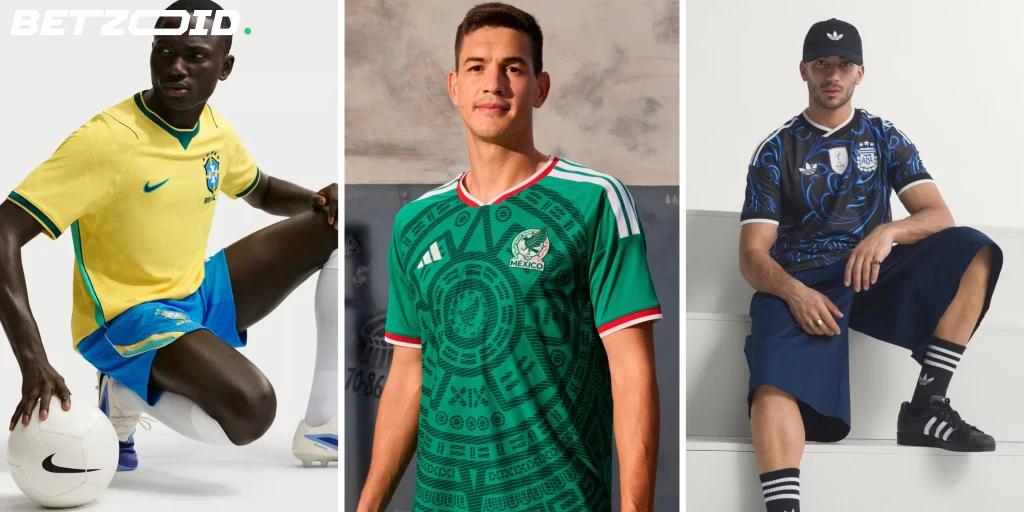
Argentina's jersey leans into legacy. The light blue and white stripes now carry a subtle gradient of three different blues, each representing one of the country's World Cup-winning jerseys. Three gold stars sit above the crest. It's nostalgia done tastefully, which isn't easy.
Brazil's canary yellow is back in its brightest form — layered green accents on the collar, cuffs, and sides. It'll be everywhere in stadiums this summer, which is fitting for a nation with five World Cup titles. Senegal's kit draws from the streets of Dakar, replicating the hand-painted car rapide minibuses in green, yellow, and red across the front. Mexico has gone full 1998 throwback with a bold Aztec design featuring an imprint of Piedra del Sol. Portugal's wavy red kit is built around maritime identity — coastal patterns, green trim, the full oceanside symbolism.
The USMNT jersey takes the stars and stripes literally, with a curvy red and white wave pattern resembling a flag in motion. It works better than it sounds.
Authentic or replica — what to actually buy
Once you've picked your team, you'll face the authentic vs. replica decision. Here's the short version: authentic jerseys are the same shirts players wear on the pitch — slim fit, technical fabric (Nike Aero-Fit, Adidas Heat.rdy), heat-pressed crests, laser-cut vents. Replica jerseys are the officially licensed everyday versions — looser fit, embroidered badges, heavier fabric, and 40-50% cheaper.
The easiest way to tell them apart without looking at a price tag? Use your hands, not your eyes.
- Authentic fabric has a thin, almost papery technical feel. Replica feels like a regular t-shirt.
- Authentic crests are woven or bonded flat into the fabric. Replica badges are raised with embroidered stitching.
- Authentic jerseys have laser-cut ventilation holes and a noticeably slimmer, tapered cut.
- The neck tag will tell you exactly which version you're holding. If a seller won't confirm authentic or replica, that silence is the answer.
Davis's recommendation for most people is the replica. It's built to survive being worn regularly, washed repeatedly, and sat in for 90 minutes with a beer. The authentic is a collector's item as much as a shirt. "Neither is the 'lesser' choice," he says. "They're built for different lives."
The tournament kicks off this summer. Pick your team, pick your fit, and check the neck tag before you hand over your card.