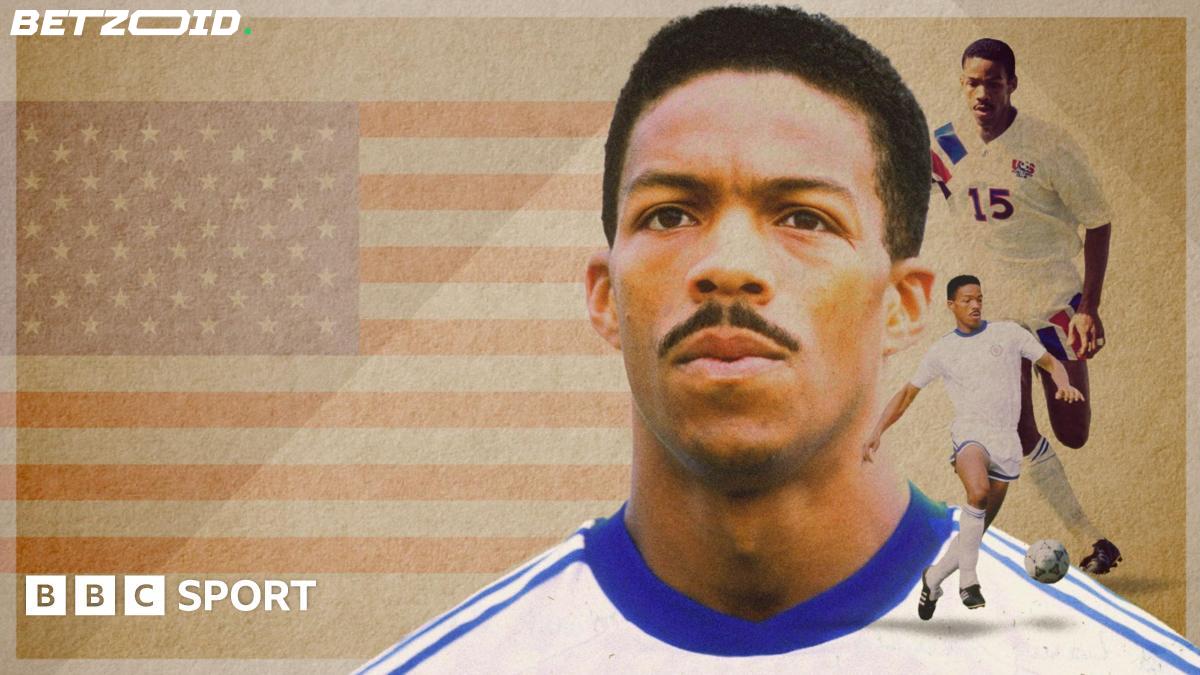
"If my folks didn't move into the suburbs, then hands down I'm not playing soccer." Desmond Armstrong says it plainly, without self-pity — but the weight of that sentence says everything about what American football was, and still is.
Armstrong grew up in Southeast Washington DC before his family relocated to a predominantly white neighbourhood in Maryland. That move put him next to a soccer coach's son. One afternoon, the coach pointed him toward a TV screen showing a Brazilian in a New York Cosmos jersey. It was Pelé. "His movement reminded me of a lot of the point guards that played basketball, but he was doing it with a ball at his feet," Armstrong recalls. "He was one of the few black players on the team, so that connected me."
Built on privilege, not passion
While Pelé was popularising a game learned barefoot on the streets of Brazil, American grassroots football was being constructed almost entirely on money. No Ajax academy model. No Barcelona youth pipeline. Just a pay-to-play system that priced out the families who couldn't afford it.
"This is the simplest game with the easiest access," says Frank Dell'Apa, who spent 40 years covering football for the Boston Globe. "Everybody plays it around the world with no money, no soccer balls, no shoes. And here, we had just the opposite thing going on."
That structural flaw hasn't gone away. It's one reason US Soccer continues to debate why its player pool lacks depth in certain demographics — and why the pathway to the national team has historically favoured those with means. With World Cup 2026 arriving on home soil, those questions are louder than ever.
Armstrong navigated all of it. The NASL collapsed in 1985 while he was still in college, wiping out professional pathways before his generation even had a chance to use them. "For me, personally, that was crushing," he says. He pivoted to the Major Indoor Soccer League, performed well enough to earn a national team debut in 1987, and made the 1988 Seoul Olympics squad.
An impossible task in Italy
With FIFA handing the USA the 1994 World Cup hosting rights in 1988 — the first time the tournament had gone to a country outside Europe or Latin America — the federation scrambled to build something resembling a competitive team. There was no elite outdoor professional league. The player pool was a patchwork of college players, semi-pros, and indoor league veterans.
Their solution was unorthodox: put a core group on full-time national team contracts, effectively turning the squad into a professional outfit. German-Hungarian coach Bob Gansler was brought in to run it. Armstrong was part of that group handed what Dell'Apa describes bluntly: "The US was not a factor in world soccer at all."
They played on artificial turf. They fought for stadiums. They scratched for relevance in a country that barely acknowledged their sport existed. And yet they qualified for the 1990 World Cup in Italy — a result that, in context, deserves far more recognition than it typically gets.
"I remember being on the field, hearing the national anthem and just thinking 'this is where I'm supposed to be,'" Armstrong says of his Olympics debut. That feeling carried a generation of American players into rooms they had no business being in — and changed what came after.