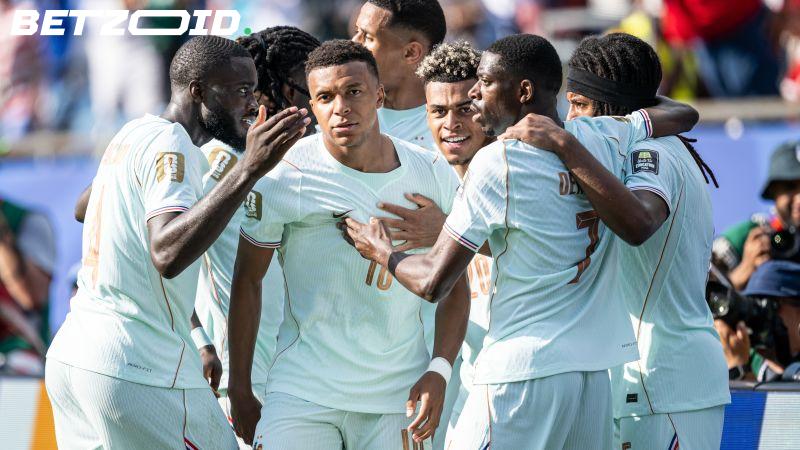
"If I score, I'm French. If I don't score, I'm Arab." Karim Benzema said that in 2011. Fifteen years later, Kylian Mbappé — French captain, World Cup semi-finalist, second-highest scorer in World Cup history — is still living inside the same sentence.
France face Spain on Tuesday. If Les Bleus win, they reach their third consecutive World Cup Final. Mbappé will be a hero. And if they lose? We already know what happens. It happened after Euro 2020, after the 2022 World Cup Final. The goals stop mattering. The passport gets questioned. The slurs come out.
A target with or without the ball
After France beat Paraguay in the Round of 16, Paraguayan senator Celeste Amarilla posted a racist attack calling Mbappé a "colonized Cameroonian, pretending hard to be French" and comparing him to a chimpanzee. She later called it a heat-of-the-moment remark. Then, in a move that defies parody, she accused Mbappé's rejection of her racism of constituting gender-based violence.
Emmanuel Macron defended Mbappé publicly on X. Marine Le Pen, the far-right National Rally leader and favourite to win France's 2025 presidential election, said nothing.
That silence is its own statement. Le Pen has spent years building a political identity around questioning who truly belongs in France. When Mbappé urged voters to be wary of the National Rally ahead of the 2024 elections, Le Pen's response was revealing: because Mbappé earns a fortune, he no longer represents immigrants, she argued. Success, in her framing, strips you of your background. It's a convenient logic — one that makes minority achievement permanently disqualifying.
Mbappé is of Cameroonian and Algerian descent, born in Paris. He scored a goal in a World Cup Final at 19. He now has 20 World Cup goals, trailing only Lionel Messi all-time. None of that has closed the debate about whether he's really French.
The 1998 myth and what came after
There's a version of this story that France told itself in 1998. Zinedine Zidane, Thierry Henry, Lilian Thuram, Marcel Desailly — a multiethnic squad won the country's first World Cup and the streets erupted. The team was nicknamed "Black, Blanc, Beur" — Black, white, Arab — a riff on the tricolore. Marcel Desailly called it "a moment of communion."
It didn't last. Jean-Marie Le Pen called that squad "artificial" and said none of them had any place in a French team. By 2011, the then-coach Laurent Blanc was reportedly involved in discussions about quotas to limit players of African descent on the national team.
The French team that exists today — diverse, successful, politically vocal — is a direct descendant of that 1998 side. The attacks it faces are a direct descendant of what followed.
Five years ago, after France were knocked out of Euro 2020 by Switzerland in a penalty shootout, Mbappé took the decisive miss. What followed wasn't just sporting criticism. He was 22 years old, receiving messages calling him a racial slur and suggesting he be "sold in Libya." He told FFF president Noël Le Graët he was done: "I cannot play for people who think I'm a monkey."
He stayed. He always stays. He went on to captain France to a World Cup Final, then another. He's now the most decorated active player in World Cup scoring history behind Messi. And he's still having to prove he belongs in the shirt.
Patrice Evra put it plainly in 2022: "When you win with France, you're a French player. When you lose, suddenly, you get your Senegal passport."
France are 90 minutes from a World Cup Final. Mbappé's odds of winning the Golden Boot look strong; his semifinal against Spain is the defining match of the tournament so far. But what happens after the final whistle — whatever the result — will tell you more about France than any football statistic.