The 2026 FIFA World Cup is barely a week old and it's already generated more off-pitch drama than most tournaments manage in their entirety. Referees, visa denials, political protests, and ticket prices that make your eyes water — this one's going to be a ride.
The moment that mattered most — and who wasn't there to see it
Start with the story that actually hurts. Cape Verde goalkeeper Vozinha, 40 years old and playing in his country's first-ever men's World Cup match, made seven saves against Spain — the reigning European champions — and earned a 0-0 draw that nobody saw coming. He was named player of the match. He wept on the pitch afterward.
His mother wasn't there. Not because she didn't want to be.
"My mom, she didn't manage to be here because of the money you have to pay for the visa," Vozinha told reporters. "We didn't manage on time, and I would like her to be here." He also lost his grandparents in recent years — the people who raised him. The tears made sense. A man plays the greatest match of his life, a match that stops an entire country, and the person he most wants to share it with is sitting at home because the US visa process is expensive and slow. It's a gut-punch of a story that no highlight reel can fix.
Meanwhile, Somali referee Omar Artan was denied entry to the United States altogether after being stopped at Miami International Airport. US Customs and Border Protection cited "vetting concerns" and alleged association with suspected terror organization members. Artan said he had the right visa and called it the biggest disappointment of his life. He's since returned to Mogadishu, where thousands greeted him at a stadium. FIFA lost a qualified official. Somalia is one of nearly 40 countries whose citizens face US entry restrictions under current immigration policy.
On the pitch, the red cards were flying
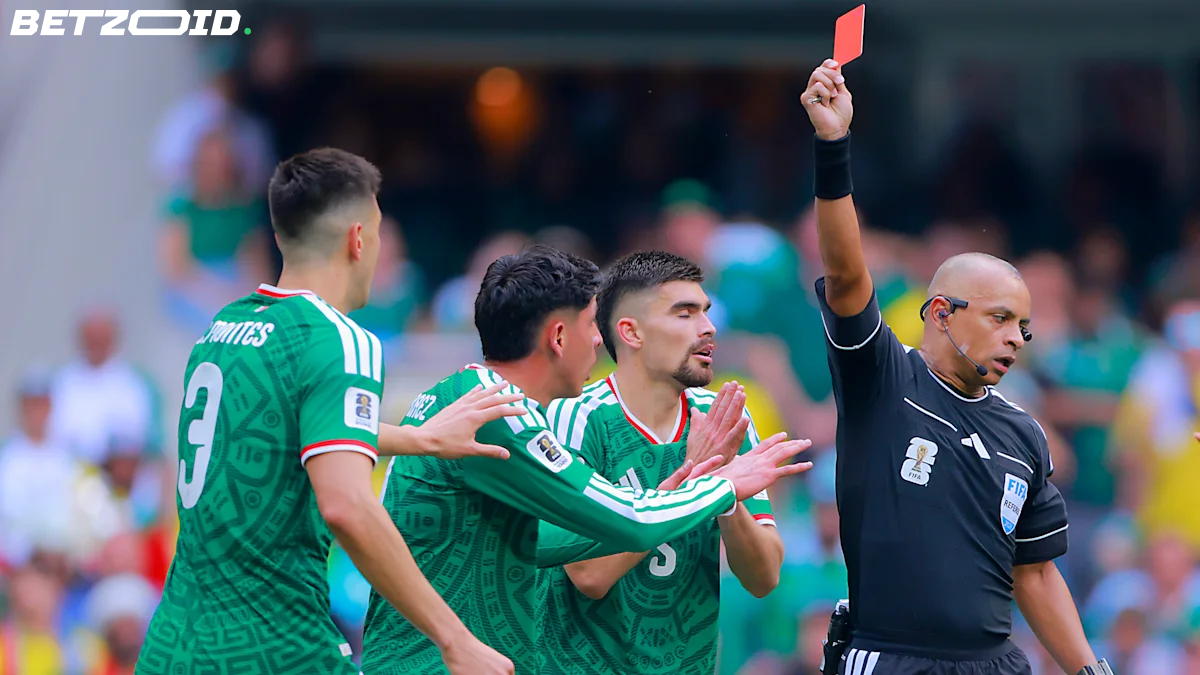
The tournament's opening match between South Africa and Mexico saw three players sent off — South Africa's Sphephelo Sithole and Themba Zwane, and Mexico's César Montes. Three red cards in one game is the highest count in a World Cup match since the infamous 2006 "Battle of Nuremberg," when Portugal and the Netherlands set a record of four ejections. For context, the entire 2022 Qatar World Cup produced only four red cards total.
Those suspensions matter. South Africa lose two players for their next group game, Mexico lose one. Anyone pricing up those matches needs to factor that in — a depleted South Africa side looks considerably more vulnerable, and Mexico's defensive options just got thinner.
Elsewhere in referee chaos, Australian VAR official Shaun Evans found himself at the center of a controversy after cameras caught him forming a circle with his thumb and index finger — a gesture adopted as a white supremacist symbol. Monitoring group Fare called it intentional and demanded FIFA act. FIFA investigated and found no breach of its disciplinary code. Evans said it was an "involuntary twitch" and pointed out that images later showed him repeating the same movement multiple times while holding a pen. Whether you believe him or not, FIFA closed the case.
Iran, empty seats, and ticket prices that need their own visa
Iran's situation is something else entirely. After drawing 2-2 with New Zealand, coach Amir Ghalenoei said his squad was ordered onto a plane to Tijuana minutes after the final whistle, cutting short any recovery time. The team's base camp had already been moved from Arizona to Mexico following the outbreak of the US-Israel war against Iran in February. "They didn't even give us time to recover," Ghalenoei said. "After the game today, they said to us, 'You have to leave immediately.'" FIFA and the US State Department have not responded to requests for comment.
At the match itself in Los Angeles, Iranian fans split along political lines — some backing the national team, others waving pre-1979 revolutionary flags and booing their own side in protest against the Tehran government. FIFA had tried to restrict politically charged flags and apparel. Fans walked through security with them anyway.
Then there are the seats — some of which are apparently optional. Viral images from the South Korea vs. Czech Republic match in Guadalajara showed large blocks of empty seating. FIFA's response was that it was nearly sold out and fans were just "standing in concourses." Similar images emerged from Switzerland vs. Qatar and Japan vs. Netherlands, where volunteers reportedly filled vacant seats for television. Meanwhile, the cheapest group-stage tickets started at $140 — double the $69 entry point at Qatar 2022. World Cup Final tickets in New Jersey were initially listed at $8,680, then raised to $10,990, then to $32,970. The 2022 final's most expensive ticket was around $1,600. FIFA says it has sold over 6 million tickets. The empty seats remain unexplained.