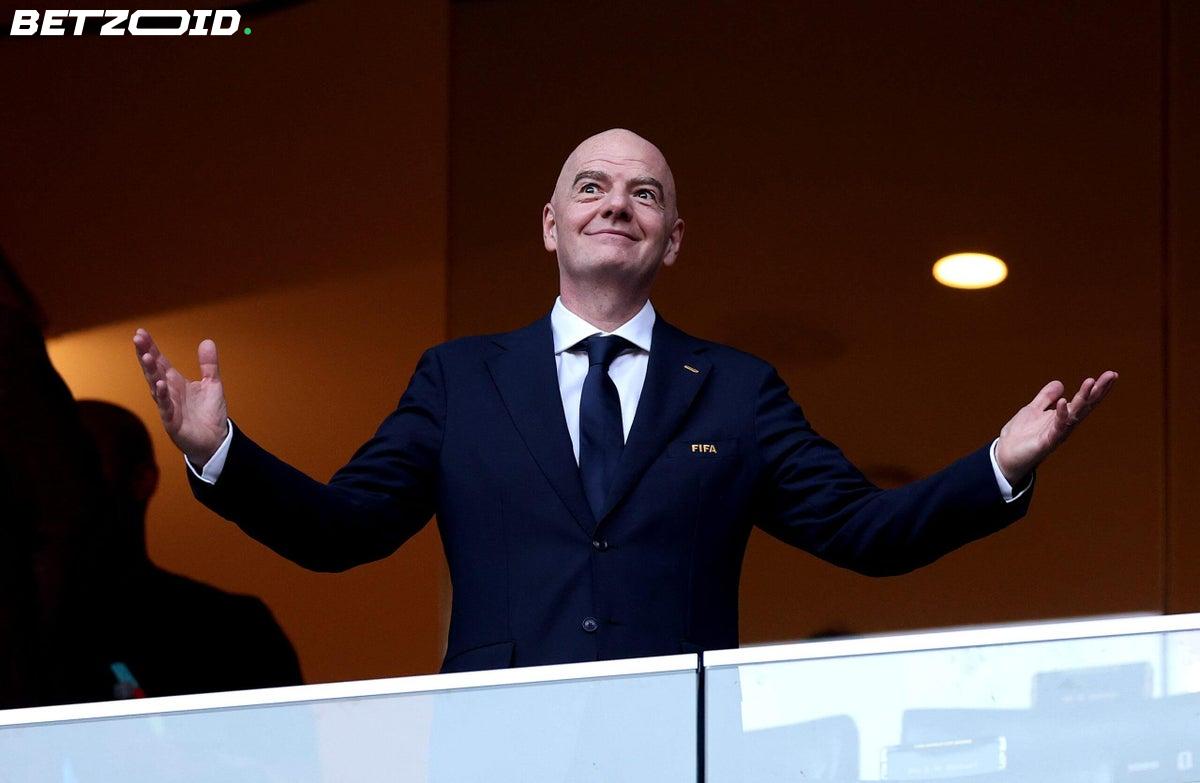
Every World Cup game, without fail, the director cuts to Gianni Infantino sitting in the stands. It is not a coincidence. It is contractual.
FIFA's production house, Host Broadcast Services (HBS), operates under an agreement with FIFA that requires a "dignitary shot" in every half of every match — capturing the highest-ranking officials and so-called VVIPs present at the stadium. Heads of state, confederation bosses, celebrities, federation officials. And, almost always, Infantino himself. Every broadcaster in the world — Fox Sports, the BBC, Telemundo, ITV — uses HBS footage. None of them chose to show him. They had no choice.
The private jets, the instructions, the optics
This goes back further than the current tournament. At the 2022 men's World Cup in Qatar, The Times of London reported that emails were sent to television crews specifically instructing them to capture Infantino on camera — with the additional note that he should not be shown on his phone. Someone, somewhere, was paying close attention to his image management.
At this World Cup, Infantino has been attending two matches per day during the group stage, shuttling between venues on a private jet provided by Qatar Airways — a FIFA sponsor. Qatar also previously provided his residence in the Gulf State ahead of 2022. On June 11, he flew 285 miles from Mexico City to Guadalajara to catch a second game that evening. On June 15, Seattle to Los Angeles for the same reason.
FIFA's line is that the dignitary shot is standard practice and applies to whoever is present — not specifically Infantino. A spokesperson said: "It is standard practice for seats which include football officials, public figures and celebrities to be shown as part of the match running order, whoever they may be."
That argument would carry more weight if other competitions worked the same way. In the Premier League, there is no mandate to show chief executive Richard Masters during matches. UEFA president Aleksander Ceferin gets airtime at the Champions League final — not at every group stage fixture throughout the season. The World Cup treatment is not industry standard. It is specific to FIFA, and specific to this moment.
Why the timing matters
Infantino has announced he intends to run for a third term in 2027. If successful, he would hold the FIFA presidency until 2031 — 15 years in total. He is currently running unopposed. The governing bodies for Africa, Asia, and South America, representing 110 of FIFA's 211 member associations, have already pledged their support.
Global broadcast exposure at the most-watched sporting event on earth is not an irrelevant backdrop to that campaign. Every time a director cuts to him in the stands — composed, presidential, in frame — it reinforces the image of a man in charge of world football. Whether that was the original intent of the dignitary shot agreement is a question FIFA has not answered directly.
- HBS is 49% owned by FIFA, majority-owned by parent company Infront, which belongs to Chinese firm Wanda
- HBS has offices in Zug, Switzerland, London, and Miami
- All global rights-holders are obligated to use HBS footage
Some nations at this tournament are openly unhappy with FIFA — over refereeing decisions, disciplinary processes, and the organization's handling of Donald Trump's travel bans, which affected supporters from four competing countries. Whether any of that translates into a serious challenge to Infantino's re-election remains an open question. Right now, no challenger has emerged.
At 56, Infantino is the unchallenged face of world football — and the broadcast deal ensures that, quite literally, you cannot watch the World Cup without being reminded of it.