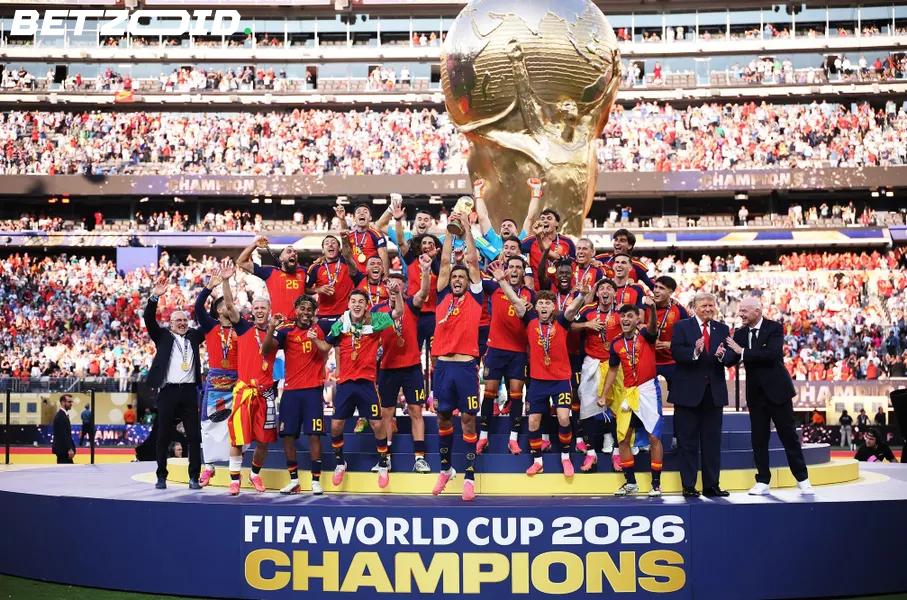
The 2026 World Cup final between Spain and Argentina was framed in some quarters as "Palestine versus Israel" — a football match reduced to a proxy conflict before a ball was kicked. If that doesn't tell you what the World Cup has become, nothing will.
Once Gianni Infantino handed Donald Trump FIFA's inaugural "Peace Prize" last December, the tone was set. The tournament that followed was always going to carry weight beyond the pitch. And it did — Trump's intervention in the Balogun red card case was a blunt reminder that someone with no footballing mandate had inserted themselves into the mechanics of the game's biggest competition.
The 2030 picture is already complicated
Six host nations. Potentially 64 teams. Argentina, Paraguay and Uruguay sharing duties with Morocco, Portugal and Spain. The logistical headaches alone would be enough — but the political fault lines running through that list are something else entirely.
Morocco and Spain are already squabbling over who hosts the 2030 final. Morocco has gone as far as constructing the world's largest football stadium to press its claim. Madrid thinks the answer is obvious. Neither side is backing down, and neither has any real reason to.
Then there's Trump's fingerprints on the whole setup. He's recognized Western Sahara as Moroccan territory, maintains close ties with Morocco's King, and has publicly called Spain a "wasted cause" and a "terrible partner." His relationships with Argentina's Javier Milei and Paraguay's Santiago Peña add another layer. Even out of office by 2030, his gravitational pull on this tournament — through Infantino, through allies, through geopolitical leverage — isn't going anywhere.
Morocco's fractious relationship with Algeria and its ongoing Western Sahara disputes create genuine border tensions that no amount of FIFA press releases will smooth over. These aren't abstract diplomatic inconveniences. They're active fault lines sitting directly underneath a tournament that attracts four billion viewers.
FIFA's original mission is a distant memory
Founded in 1904 to unify football associations and standardize the game, FIFA's World Cup was launched in 1930 specifically to give professional footballers a global championship outside the Olympics' amateur framework. That's the origin. What it is now is something categorically different.
This summer's tournament was, by any honest measure, a convergence of neoliberal commercial logic — dynamic ticket pricing being the clearest symptom — and raw geopolitical theatre. The World Cup has become a vehicle for countries and powerful individuals to launder reputations, project influence, and settle scores that have nothing to do with football.
It's happened before in patches. In 1962, the presidents of Chile and Peru lobbied FIFA directly over Garrincha's red card. In 1974, FIFA president Joao Havelange partnered with Adidas CEO Horst Dassler to commercialize the organization from the inside out. The seeds were always there. But 2026 accelerated the process into something qualitatively new.
- Immigration restrictions placed on Iran's national team due to U.S.-Israel tensions
- A Somali FIFA referee denied entry to the United States
- Trump intervening in a red card decision involving an American player
- The World Cup final reframed as a geopolitical conflict between two governments
Each of those would have been a story on its own. Together, they mark a before-and-after moment for the tournament.
After Qatar 2022, most people stopped talking about migrant worker rights within weeks of the final whistle. The circus moved on. But 2026 feels harder to shake — the issues are too embedded in the tournament's actual structure now, not just its backdrop. By 2030, with six nations, expanded geopolitical entanglements, and no sign of FIFA recalibrating its priorities, the pressure points won't diminish. They'll compound.
Anyone pricing the 2030 tournament as "just football" is working from an outdated model.