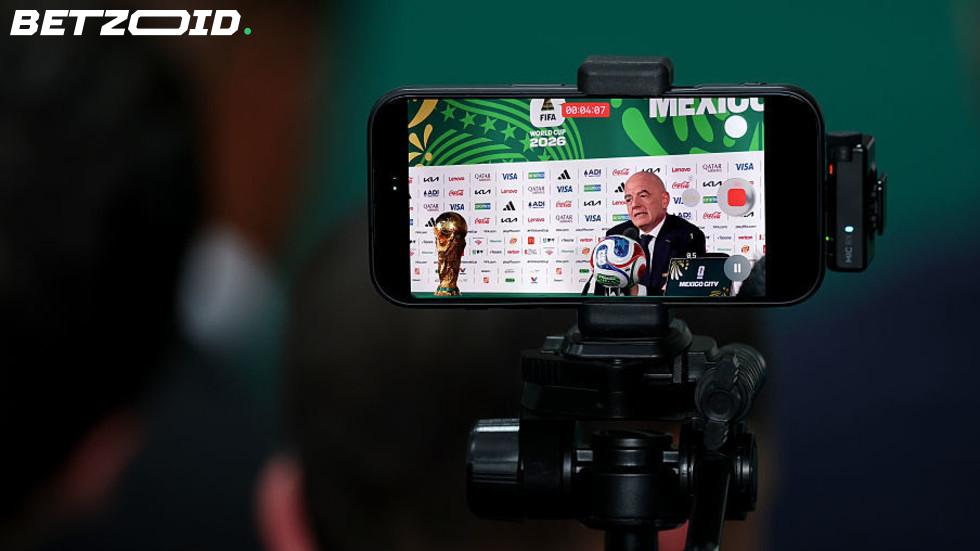
Fourteen out of sixteen sports journalists surveyed privately believe the 2026 World Cup should be postponed. Two of the remaining pair think it should be stripped from the US and Canada entirely and handed solely to Mexico. Not one of the sixteen thought the tournament should go ahead as planned — and yet every single one of them is travelling to cover it.
That contradiction is the story of this World Cup, and the sports media isn't going to tell it.
The silence has already started
One journalist working with a European broadcaster had posted a detailed, well-received critique of FIFA awarding its Peace Prize to Donald Trump. Hundreds of likes. Gone. When asked why, she replied with a smiley face emoji: her agent had warned that social media posts critical of the US government could trigger a border refusal. Post deleted, accreditation secured.
She's not alone. Across LinkedIn and Instagram, journalists who spent months publishing critical takes on US foreign policy or FIFA governance have quietly edited or removed those posts. The World Cup is on, the press passes are printed, and the mortgages need paying. As one of the sixteen put it — that's literally the justification. "I have to pay the mortgage."
The Guardian's Alexander Abnos wrote in May that the US "is not fit to stage soccer's showpiece event" and that "it would be hard to argue if the World Cup was moved out of the US entirely." Strong stuff. By June 1, he was writing about USMNT "memeable moments" and visual stadium guides. That's not hypocrisy — that's the job description now.
The safety picture nobody is printing
A FIFA insider with the organisation since 2004 described this as "the most dangerous World Cup ever" — and noted that, for the first time in his experience, staff are turning down the chance to attend. FIFA has reportedly allocated around $650 million to security across host cities. That figure alone tells you something about the threat assessment.
The last successful attack at a mega-event was Atlanta 1996. At the 2018 World Cup Final in Moscow, pitch invaders dressed as police officers disrupted the France vs Croatia match while hundreds of millions watched. NPR's Scott Simon called it "a conspicuous act of bravery." If copycats are inspired this summer, the consequences could be considerably worse.
In a German fan WhatsApp group with over 1,000 members, the debate isn't whether to worry — it's which match carries the highest risk. One supporter from Wiesbaden flagged Germany's middle group game against Côte d'Ivoire in Toronto as the "soft underbelly." "It could be bombs and bedlam," he wrote. These are ordinary football fans, not security analysts, running their own threat assessments because the media isn't doing it for them.
- 14 of 16 surveyed journalists believe the tournament should be postponed or relocated
- FIFA allocated ~$650 million to security — a record for any World Cup
- A FIFA staff member with 20 years at the organisation called it the most dangerous edition ever
- Journalists are self-censoring social media on advice from agents to avoid border issues
Gianni Infantino was never going to postpone the tournament or strip the US of hosting rights. That was always fantasy. But the sports media's job isn't to carry FIFA's water — it's to report what's actually happening. Right now, what's happening is that the journalists covering this event largely don't think it should be taking place, and they're covering it anyway while the posts that said so quietly disappear.
The football starts June 11. The brainwashing, by most accounts, already has.