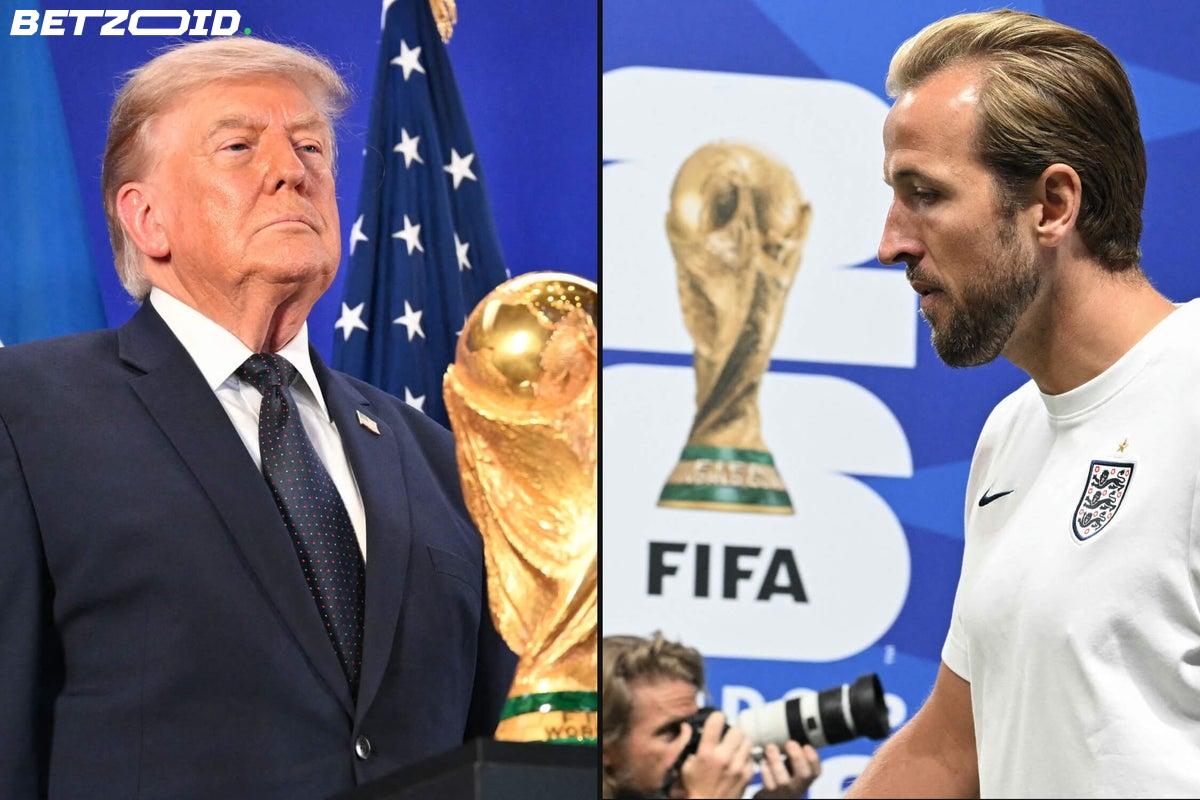
"I think they made a mistake when they made him a defensive player." Donald Trump, standing next to FIFA president Gianni Infantino at a pre-final press conference, just stumbled into one of English football's longest-running arguments.
He's not wrong. He's just wrong about why.
Trump was reacting to England's semi-final loss to Argentina, where after Anthony Gordon's 55th-minute goal, Thomas Tuchel's side sat back, surrendered possession, and effectively stopped playing football. Kane, a 32-year-old with 82 international goals and a genuine Ballon d'Or candidacy before this tournament began, spent the final half-hour making clearances and winning headers. Not exactly what you build a team around.
The Kane Debate Isn't New — Trump Just Joined Late
Here's the thing: Kane has never been a penalty box forward. Not at Spurs, not at Bayern Munich, not for England. His game is built on dropping into midfield, linking play, spraying 40-yard passes that stretch defences. The goal he helped create against Argentina — receiving the ball deep in his own half from Reece James, then driving a raking pass upfield that forced a botched Tagliafico clearance, leading to Rice recovering and Gordon eventually scoring — that's not an accident. That's Kane doing exactly what he does.
Bayern used him the same way last season. In their Champions League semi-final against PSG, it was a Kane pass from deep that created Luis Diaz's goal in a 5-4 thriller. He still scored 50 goals across 44 Bundesliga and Champions League appearances. The deep role didn't cost him goals. It made him the most complete centre-forward in the world.
The argument against it, though, has merit — especially for England specifically. Their midfield trio of Declan Rice, Elliot Anderson and Jude Bellingham are all progressive ball-carriers, not distributors. None of them consistently delivers the kind of long, diagonal pass that opens up a compact defensive block. Kane is, genuinely, the only player in this squad who can do that reliably. So England's system leans on him for it.
Why This Isn't Going Away
The cost of keeping Kane deep is real. Without him high up the pitch, Anthony Gordon and Morgan Rogers lose a target to run off. Opponents don't need to pin their defensive line as deep. England become more predictable, not less, despite the apparent tactical logic.
Could Kane play a hybrid version — less deep, still involved in buildup, but threatening the box more often? Almost certainly. Would that have helped against Argentina once England retreated into a defensive shell? Probably not, because that decision was on Tuchel, not Kane.
Trump called it a coaching mistake. He's gesturing at the right target, even if his analysis starts and ends at "he should be up front." The more uncomfortable truth for England fans is that this debate has followed Kane through 121 caps, three major tournament near-misses, and a record 82 international goals — and nobody has ever found a clean answer to it.
At 32, with England eliminated and the Ballon d'Or conversation now moot, he may never play at another World Cup. The debate, however, will outlast his career. It now just has a rather unusual new participant.